Showing posts with label â. Show all posts
Showing posts with label â. Show all posts
Friday, December 9, 2016
Ceuta – A little piece of Spain in North Africa
17 March 2013
I think I have mentioned before, the most important thing to remember about cruising plans is that they are just plans, not a must follow to the minute schedule for strict adherence with no flexibility. I raise this again because our plans have changed again.
We arrived here in Ceuta on the North African coast on Thursday planning to stay until Monday morning before heading east. We had intended on lifting Alcheringa out of the water week after next in Almerimar on the Spanish coast for a hull wash, new coat of anti-fouling and to replace a seized seacock valve we haven’t been able to free up. Unfortunately the marina there informed us yesterday that they would not be able to do the work until after Easter. However, we have discovered a very well equipped boat yard right here in Ceuta and after a chat with the British manager we have decided to get the work done where we are.
 |
| Karen using one of the beautiful hand painted ceramics that are plentiful in Ceuta to point out our current location. |
As a result we will now be spending an extra week in North Africa which we don’t expect to be too hard to take. The boat will now come out of the water on Monday morning and, all going well, we will disappear over the border for a couple of days in Morocco on Tuesday while the work is being done. Definitely sounds like a better idea than sitting around Almerimar while the boat’s out of the water anyway.
We spent Friday getting all this arranged, cleaning the boat down after our crossing from Gibraltar and discovering what’s where close by the marina. We dropped into a fishing store and discovered the fish around here must be extremely dangerous going by the range of automatic weapons on display freely available for sale.

Of course we also needed to establish just which establishment in the vicinity looked good enough to warrant our business and discovered our most conveniently located ‘local’yet in the form of ‘Café Madame Pots’approximately 15 metres from the stern of the boat. Great friendly atmosphere, excellent coffee and a very nice bar with very cheap prices, what more could we ask for.
 |
| Nothing like great coffee for just One Euro only metres from the boat |
On Saturday we ventured a little further into Ceuta to explore its charms. Ceuta is a small peninsula of just 7.1 square miles (18.5k) whose strategic position on the southern shores of the Straits of Gibraltar has made it an important commercial trade and military way-point for many cultures, beginning with the Carthaginians in the 5th century BC. It was not until the Romans took control of the region in AD 42 that the port city assumed an almost exclusive military purpose. It changed hands again approximately 400 years later, when Vandal tribes ousted the Romans and has been fought over by the Byzantines, Moors, Portuguese and Spanish ever since.
 |
| Click on any image to see larger versions |
 |
| Ceuta with mountains of Morocco in the background |
In July 1936, General Francisco Franco took command of the Spanish Army of Africa and rebelled against the Spanish republican government; his military uprising led to the Spanish Civil War. The troops were transported to mainland Spain in an airlift using transport aircraft supplied by Germany and Italy. Ceuta was one of the first casualties of the uprising. The citizens of Ceuta were repressed by the rebel nationalist forces led by General Franco, while at the same time the city came under fire from the air and sea forces of the republican government. Sometimes you just can’t win.
When Spain recognized the independence of Spanish Morocco in 1956, Ceuta was considered an integral part of the Spanish state remained under Spanish rule, but Morocco has disputed this point.
The government of Morocco has repeatedly called for Spain to transfer the sovereignty of Ceuta drawing comparisons with Spain's territorial claim to Gibraltar. Both the national government and local population of around 75,000 reject these claims by a large majority and of course the Spanish government insists it's a totally different case to that of Gibraltar. We can't really see the difference but they can.
Ceuta’s architecture is an eclectic mix of styles but combine to make this a very attractive small city. It is well laid out with a number of attractive squares and the harbour front had been developed with extensive parkland and promenades. There’s the usual cathedral and churches but there are also a number of mosques as a significant proportion of the population are Islamic descendents of Berber heritage. Much of the historic fortifications still stand and the ‘Royal Walls’ with their navigable moat reaching right across the peninsula are particularly impressive and quite interesting to wander around. We discovered a military chapel within the thick walls which had been converted to a beautiful café/bar and decided it was a great spot for afternoon communion. Well we had the wine part of it anyway.
 |
| This moat stretches right across the peninsla's narrowest point opening to the Mediterranean on both sides and would have been all but inpenetrable. |
 |
| A chapel that becomes a bar, what could be better place for a nice wine |
 |
| Now that's a big pot. |
A quick trip to the supermarket saw us top up our food and drink supplies with enough for three main evening meals plus half a dozen bottles of wine and a couple of bottles of ridiculously cheap spirits producing a complete bill of 29 Euro ($37 Aus). Yep it’s good to be away from Gibraltar prices again.
After a fantastic meal of Corsican Chicken that Karen whipped up back on the boat, we headed back onto the streets later that evening for Rob to get some after dark photos of the city and to join with the masses of people out and about. Teenagers were socialising in the squares and promenading along the waterfront, while the cafes, bars and restaurants all seemed to be very well patronised. The streets were also full of children happily running around as their parents enjoyed a stroll in the city. It’s such a different atmosphere to anything we’ve experienced at home in Australia.
 |
| While Gibraltar is unquestionably the northern, Ceuta is believed by many to be the southern pillar of Hercules and the city obviously backs that claim. |
 |
| We found Ceuta to be an extremely friendly, clean, attractive city. |
 |
| Hercules Marina at night. Alcheringa is second mast from the far end. |
 |
| The House of Dragons is a building known for its Moor influenced arches, Spanish balconies, and the infamous dragon statues on top of the roof. |


 |
| Impressive architecture at every turn makes an evening stroll in Ceuta a delight. |

We love to receive comments on our blog from readers. If you do leave a comment and you also have a blog, please leave a link as well. We'd like to click over for a visit and leave you a comment too.
To stay right up to date with what we’re up to and see lots more photos check out and 'like' our Dreamtime Sail Facebook page at Dreamtime Sail

If you have only recently discovered our blog and would like to read how it all started, or work through our previous adventures, click the link to go back to our first blog entry. Stuff it. Let's just go sailing anyway.
We hope you enjoy reading the previous posts to catch up on our story.

Sunday, November 27, 2016
On to Malaysia – the final sea passage
15 – 20 October 2011
The Sail Indonesia Rally 2011 was officially over. All that remained was for the fleet to leave the country. About equal numbers were heading to Raffles Marina on the Singapore side of the Johor Straight or Danga Bay Marina at Bahru Johor on the Malaysian side. As Danga Bay was the assembly point for the West Malaysian Rally which Will and Margaret were embarking on in November, Atlantia was heading to the northern option. It also had the added attraction of free mooring fees with Malaysian Rally participants getting priority for berths.
In Belitung, the Sail Indonesia organisers had done a great job working with the Government to create a one stop clearing out process for the cruisers right on the spot at Tanjung Kelayang Beach. A couple of resort units had been set up as offices for the relevant Harbour Master/Customs/Immigration officials and the whole process proved to be very quick and quite painless. To make things easier we were permitted to formally clear out a couple of days in advance and simply nominate the date we would be leaving Belitung, and officially Indonesia. We were also provided with a letter we could show any officials we subsequently ran across that stated that although we had cleared customs and thereby without visas, we were permitted to anchor in Indonesian waters on our way to Malaysia where necessary provided we did not go ashore.
It’s first and final impressions which have the most impact and while we had some minor problems with excessive profiteering when we entered Indonesia at Kupang, every single official, volunteer and local we encountered in Belitung went out of their way to ensure our most recent memories of the Sail Indonesia Rally 2011 would be the most positive and enduring. Thank you Belitung.
While we were a little sad to be leaving as we hoisted anchor, we were also very much looking forward to getting back to sea. The beauty of cruising is that not only do you get to see so many amazing destinations, the actual process of getting their under sail is, most times, so enjoyable. The majority of people we had talked to planned a two day, one night sail to the northern end of the island of Pulau Bangka as their first leg. In contrast, Will prefers the more relaxed approach and likes to day hop, anchoring up each night where possible. On studying the charts he decided to take us on a slightly indirect course to the west and anchor at the southern end of the island for the first night. It proved to be a fortuitous choice.
 |
| Leaving Belitung - click on any image to see larger version |
October marks the beginnings of the monsoonal wet season in northern Indonesia. While the strong monsoon toughs had not yet developed, since our stormy approach to Belitung most days were falling into the early wet season pattern of bright sunshine contrasting with reasonably intense thunderstorms. As we headed on our lonely course to the north west we watched a procession of masts to our starboard sail north into an ever darkening sky. All day we watched thunderheads develop and dump their moisture as intense storms to our north, south and astern while we never so much as encountered a sun shower. It may have been pure luck but the weather gods were smiling on Atlantia and we were certainly not unhappy about it.
We reached the southern tip of Pulau Bangkar mid afternoon and decided to make the most of the remaining daylight by heading north along its eastern shore which was one very long, continuous palm fringed beach. Throughout most of Indonesia that we had sailed through the water was very deep with the islands rising sharply from the sea bed as a result of their violent, volcanic origins. As a result finding a safe anchorage can be difficult as when you approach the steeply shelving shoreline you can be in 60 metres of water one minute and two the next. In northern Indonesia however, we were finding the islands much more friendly and here an inspection of the charts showed a gently shelving bottom leading up to the sand beach virtually all the way up the coast. With the wind coming from the east, this meant we were able to sail north virtually until dark, then simply head in closer to the beach and drop anchor in relatively calm, shallow water. Click on the link to see your choice of map or satellite image of the anchorage http://www.findmespot.com/mylocation/?id=6D-qJ
After a very relaxed day’s sail it was very nice kick back and enjoy huge serving’s of Rusdi’s barbecued chilli squid washed down with a few of Will’s very nice, boat brewed, alcoholic ginger beers. Life is good.
 |
| We were intrigued by these platforms in deep water |

That afternoon we rounded a small rocky island off the northern point of Pulau Bangka to find a number of the Rally boats settled nicely in a beautifully protected and extremely attractive anchorage. Click on the link to see your choice of map or satellite image of the anchorage http://www.findmespot.com/mylocation/?id=6EWsS
When Atlantia had joined them with her anchor buried nicely in the sand it was time for sundowners again followed by Rusdi’s huge garlic prawns and rice. Life is very good.
Once underway about 6.30am next morning, Rob elected to have a go at catching at least one more fish in Indonesia. We hadn’t caught a thing since the solitary Turum we landed months ago in Larantouka and Will informed us that he and Margaret had not caught a thing on Atlantia so had eventually given up. On the way to Belitung we had lost our second last spoon lure when the wire trace kinked and broke once more. With the boat getting through the water at over seven knots, the lure darted about in the water much more violently than intended and may not only have been causing the trace to break, but may also have been unattractive to the fish we were trying to entice. As Rob pieced together the line with the last of wire he added an extra swivel into the rig in the hope that two points of rotation may extend the life of the wire trace. Out behind the boat the line went and was soon forgotten.
 |
| Rob with his wahoo - our first fish for months |
About lunchtime Rob happened to be looking astern and said he saw a big silver flash near the lure and thought something had just had a go at it. No sooner had the words exited the mouth than the fish returned and took the lure. Despite an initial moment of disbelief, we were on. Karen headed for the gaff as Rob hauled in the line which was being made more difficult by the fish’s obvious reluctance to be turned into steaks. Getting the fish to the boat was far from the end of the challenges though as Atlantia features an extreme amount of free board, for our non-boating friends, the deck is a long way above the water. Simply trying to haul the fish up the three metres or so out of the water onto the boat would risk the hook tearing out of the mouth as its full weight came to bear. With Karen leaning far over the stern rail working at full stretch, getting the gaff in the fish’s gills was not easy but again her upbringing as a fisherman’s daughter came through and we soon had a magnificent, but none too happy, Wahoo on board. A tipple of Will’s Jamaican rum poured in its gills soon calmed it down.
Wahoo are amongst the fastest fish in the ocean and prized not only as game fish but also for their fantastic flavour. Karen’s father’s game fishing charter boat was actually called Wahoo but despite catching many a fish aboard, she had never actually landed a Wahoo on Wahoo so this was a little special. We’d also broken Atlantia’s Indonesian fishing drought which Will was very pleased about. We had no idea whether the second swivel made the difference or we were simply in better fishing grounds but as long as we had a fish who cared. Karen quickly converted a live fish into an enticing collection of Wahoo steaks, bagged and in the fridge for later.
About four o’clock we reached our anchorage on the south west coast of Kapok Island which was even more beautiful than the previous couple. Crystal clear water, nice live coral easily visible on the bottom, a mix of sand beaches, mangroves and dramatic rock formations forming the uninhabited shoreline backed by dense rainforest rising very steeply to high mountain peaks creating yet another perfect vision of tropical paradise. http://www.findmespot.com/mylocation/?id=6E_lL
 |
| Rampisard at Palau Bangka Anchorage |

We were up early for a dawn departure and motored north across glassy seas all morning. The water here is very clean and clear and we delighted in watching Dolphins, large garfish, thousands of flying fish and even a couple of huge sea snakes slide by. We were getting along nicely towards our planned night stopover at a small island of when once again just after midday Rob raced sternwards as another fish was hooked. After a short but vigorous fight we had another good Wahoo aboard which Karen quickly set about cleaning.

Mainly to get the line out of Karen’s way on the stern Rob threw the lure back over and unbelievably no sooner was all the line out than we had another hookup. Karen switched from cleaning to landing a fish, hauling in an even bigger Wahoo. This time the line got wound up and put away in case we caught any more. There’s only so much room in the fridge. After one fish in three months we had suddenly landed three beautiful Wahoo in two days and had to put the cue in the rack and stop fishing because we were full up. Talking about fast to famine.
 |
| Crossing the equator wasone of the milestones of the trip. |
http://www.findmespot.com/mylocation/?id=6FVaL
We duly toasted the occasion with a small ginger beer and made sure old King Neptune also received his dram of the same. We were saving the good stuff until we got the anchor down which fortunately wasn’t too far away.
 |
| We carried this bottle all the way from home for this moment |
A number of boats that had been travelling ahead of us were sitting at anchor with their crews ashore enjoying an equator party but as it was virtually dark by the time we settled in place we elected to stay aboard. Out came the bottle of Veuve Cliquot we’d been carrying around with us ever since we left home and we celebrated our crossing in style as the last of the sun’s glow lit the western sky behind us. Another dinner of fine seafood followed.
 |
| Waterspout visible on the other side of the island |
We headed north towards our final stop before Malaysia and found ourselves sailing in company with the big Australia catamaran Splash Down and the German Ketch Nuka A Loofa while most of the boats headed further east . Again the weather gods favoured our choice of course as we watched as storms built to the east and at one stage saw a huge waterspout twister which we heard some of the boats having to alter course to avoid.
Will had studied the charts searching for an anchorage we could get to in the day but that would leave us within reach of the Singapore Straights and Malaysia the following day. He picked an area between two small islands off the south east coast of Batam. As usual the radio chatter was about how are you going and where are you planning on anchoring. Both Splashdown and Nuku A Loofa were heading for a listed anchorage not far along but when they heard about Will’s plan and had a look at their charts they realised that by pushing on a little further they could be in Danga Bay Marina a day earlier than they planned and soon elected to join us. That suited us fine because – we had a small truckload of Wahoo on board so we soon invited both boats for dinner that night.
The anchorage proved to be perfect, well sheltered spot, not too deep with a good sand bottom to hook up on. The link will show you the anchorage but make sure to look at the satellite version for a better idea of its layout. http://www.findmespot.com/mylocation/?id=6F_ew
 |
| We had almost enough wahoo to go round |
Cooking for a large group in a small galley with two burner stove is not easy but that evening Karen worked her magic again serving up dinner of wahoo steaks with vegetables in ginger and oyster sauce for eight as Helmut and Renata off Nuku Aloofa along with Colin and Bev along with their eleven year old son Alex from Splashdown joined us for what turned out to be a very enjoyable final evening in Indonesia. Karen has taken a shine to Alex and they enjoyed some boisterous play all over the boat. It showed how much she misses the boys back home.
The other two boats were away a bit earlier than us the next morning opting to take the western route right around the Batam Islands to the Singapore Straights while Will was again marching to the beat of a different drum. He’d decided we would take a short cut through a slightly narrow and twisting channel between the islands that he’d spotted on the charts. Again it turned out to be an inspired choice as unbeknown to us it was to provide yet another high point of our travels.
 |
| The shipyards stretched for almost 20 nautical miles |
 |
| I hope he's going to turn soon - very soon. |
We got our first glimpse of the high-rises of Singapore as we cleared the northern end of the channel and had but to dodge a few high-speed ferries and weave through the last few islands before entering the fabled Straights.
Oh my god! No amount of previous discussion prepared us for the sheer volume and size of the shipping in the Straight between us and Singapore. There were super-tankers far larger than anything we’d believed possible, container ships, freighters, bulk carriers and other tankers of all shapes and sizes and at first glimpse all seemed intent on running us over.
 |
| Oh shit! We have to get through that lot to Singapore. |
This is when our AIS system should have come into its own. Instead it detected so many targets it simply overloaded and froze up. OK back to old fashion Mark One eyeballs.
 |
| Aim to just miss the stern to avoid the next one behind |
Step one over, we then had to make our way to the Johor Straight around the west coast of Singapore through a series of channels and literally thousands of ships of all sizes both underway and anchored. We both agreed that we saw more ships in a single day than we have in a lifetime.
 |
| There really wasn't a hell of a lot to spare. |
Just after 4.00pm on October 20 we slipped into Danga Bay Marina and tied Atlantia up alongside for the first time since Marlin Marina in Cairns, Australia. To see where we moored in the marina click the link and have a look at the satellite image, http://www.findmespot.com/mylocation/?id=6GUze
It was certainly good to be able to step ashore without using the dingy but it also meant that our sailing adventures had come to an end for the time being and our time with Will on Atlantia was drawing to a close, but not quite yet.
To stay right up to date with what we’re up to these days and see lots more photos check out and 'like' our Dreamtime Sail Facebook page at Dreamtime Sail on Facebook

To stay right up to date with what we’re up to these days and see lots more photos check out and 'like' our Dreamtime Sail Facebook page at Dreamtime Sail on Facebook
If you have only recently discovered our blog and would like to read how it all started, or work through our previous adventures, click the link to go back to our first blog entry. Stuff it. Let's just go sailing anyway. We hope you enjoy reading the previous posts to catch up on our story.
Friday, September 30, 2016
Mooloolaba to Manly – Journey’s end
After a few days enjoying the delights of Mooloolaba we had to face the fast approaching end of our five month shakedown cruise through many of Australia’s fantastic Great Barrier Reef Islands. It was time for the final leg from Mooloolaba via Moreton Island back to homeport at East Coast Marina in Manly boat harbour.
We eased out between the breakwaters of Mooloolaba shortly after dawn, rounded point Cartwright and headed south. We had expected a nice north-easterly but in the early morning it wasn’t strong enough to fill the canvas so we motor sailed towards Caloundra.
 |
| Sailing past Caloundra |
As it turned out, the wind never filled in all day and our 80 HP Ford Lehman was required for duty the whole 35.1 nautical mile trip as we skirted the main shipping channel into the Port of Brisbane dodging massive container vessels.

 |
| You would swear they were out get us but unless they left the channel we were always safe. |

 |
| We skirted just outside the main shipping channel with these guys passing close by. |
We anchored in behind the wrecks just north of Tangalooma Resort on Moreton Island in time for lunch and a relaxing afternoon, for us anyway. Marc went ashore for a walk on the beach and set out to climb the sandhills to take in the view. The most strenuous activity we got up to was trolling a lure behind the dinghy for a few circuits of the wrecks unsuccessfully trying to catch some dinner.
 |
| Mooloolaba to Tangalooma - 35.1 Nautical Miles - 5 Hours 59 Minutes Average Speed 5.9 knots - Max Speed 7.6 knots |
 |
| Where we anchored behind the wrecks. |
Later we did enjoy a typically awesome Tangalooma sunset dutifully accompanied with some of our fast dwindling wine supplies and another great meal from Karen.
 |
| In the distance the cranes of the Port of Brisbane and the Brisbane CBD high rises remind us how near the end we are. |
 |
| The sunsets from Moreton Island are legendary. |
Next day we moved down the shore to the southern side of the resort to get away from the crowd of day boats all intent on cramming in behind the wrecks. We went ashore to the resort for a wander around mid morning. We retired to one of the pools for a long, lazy soak while Marc headed off for a long walk to an area of the island called “The Desert”. He was quite enjoying the opportunity to get some exercise and this reasonably long walk through sandy, undulating tracks certainly gave him a workout.

We returned to the boat mid afternoon and settled back doing a whole lot of nothing much. Marc appeared on the beach a couple of hours later ready for pickup in the dinghy. He was very impressed with the walk and found the desert experience in the middle of a heavily vegetated island quite surreal.
 |
| The local dolphins made an appearance for quite a while around the boat around sunset topping off a very enjoyable day. |
The following day we planned to move further south along the Moreton Island coast to one of our favourite anchorages at a spot appropriately named “The Sand Hills”. Here we were going to be joined by our neighbours from East Coast Marina, Bob and Lyn on their ketch, Whoosh. Over drinks that night, Rob jokingly said to Marc that as he was enjoying his hiking so much he might like to walk down the beach to our next stop, after all it was only seven and a half miles.
To our surprise, Marc appeared at breakfast next morning with the plan to do just that. So with a good supply of water, a few muesli bars for sustenance and Brit resolve he was dropped to the beach and off he headed. Meanwhile we settled back for another cup of coffee and a read of the online newspapers.Seven and a half nautical miles is almost 14 kilometres so we gave Marc two hours head start before we raised the anchor and slowly cruised along the coast keeping a lookout for our mad mate ashore. It surprised us how far along he’d gone by the time we passed him by. We were able to anchor up and settle in well before he reappeared on the beach waving to be picked up.
 |
| Where we anchored at the Sand Hills |
 |
| Doing it tough waiting for Marc to arrive along the beach. |
The anchorage at the Sand Hills shoals very gradually out from the beach making it necessary to anchor a few hundred metres offshore. The shallows dry at low tide leaving you with a long walk back to reach even enough depth for a dinghy. As it was approaching low tide Marc elected to wade out off the beach into thigh deep water to make it easier for Rob to reach him in the dinghy. It was about now he remembered what we had told him about the large number of stingrays that frequent these shoals and was feeling relieved he hadn’t come across wading through the shallows.
As Rob approached Marc in the dinghy, it spooked a group of six or eight large rays boasting spans of over a meter that had been resting in the sand. They all began fleeing the approaching dinghy – straight towards Marc whose face immediately took on a look of ‘deep concern’. Recounting later seeing a swarm of huge Australian marine life charging his way through the clear water, Marc refused to class his facial expression as near panic.
Whether it was a logically sensible decision made to keep very still or he was frozen to the spot we are not sure but it proved to be the right strategy as all the rays made last second diversions around him and fled on their way . Stingrays are not aggressive but instinctively strike with their venomous tail if threatened. Sudden movement can do it.
After surviving yet another encounter with Australia’s deadly fauna Marc was well ready for a glass or four of red as told us of his trek along the beach and some of the sights he come across.
 |
| Marc enjoyed his long beach walk |
 |
| He was very saddened to find someone's cruising dreams washed up on the beach |
 |
| The wreck of an old steamer Marc came across on his walk |
 |
| Just another Moreton Island sunset over Brisbane city |
We spent the next couple of days at the sand hills with Marc going ashore for more hikes while we did some exploring of the shallows in our kayak getting very up close and personal with a number of huge rays, turtles and scores of shovelnose sharks.
 |
| We explored the shallows in our kayak |

 |
| Turtles abound in the area |
We also fitted in a little fishing, crabbing and a lot of socialising with the crew of Whoosh including enjoying sundowners from high on the sand hills one evening.
 |
| One last mackerel for the trip |
 |
| Quickly dispatched and on the BBQ |
 |
| Pelicans were also plentiful |
 |
| Marc's skin tone clearly benefited from a few months in the Aussie sun. |
 |
| If you didn't know better you could easily believe this was a snow field rather than sand. |
 |
| Marc's attempt at sand boarding was an abject failure |
 |
| Sundowner drinks with Bob & Lyn from Whoosh atop the sand hills |

 |
| The view was spectacular |
Time was now almost up and finally we waved good bye to Whoosh, upped anchor and enjoyed a very pleasant sail back across Moreton Bay towards home port. We weren’t quite done yet though as we dropped anchor at Green Island for one final night out of the marina.
 |
| Sand Hills to Green Island - 13.4 Nautical Miles - 3 Hours 13 Minutes Average Speed 4.1 knots - Max Speed 7.2 knots |
 |
| The moon waning over us anchored off Green Island |
As Karen cooked up a superb last supper aboard for the three of us, Marc emerged from rummaging around under the sole where we store the wine with the sad proclamation, “Chaps, I’m extremely sorry to report that we are now officially out of red wine. Your calculations of our requirements was almost perfect. If I hadn’t spilled so much we would have made it.”
After a good laugh from us, the good news was the bubbles and white stocks were still OK but did get knocked around through the evening.
 |
| We spent the night literally within sight of the marina. |
At 8.35am on December 22nd Our Dreamtime slipped quietly into her berth at East Coast Marina in Manly Boat Harbour officially ending our five month sojourn to the tropics.
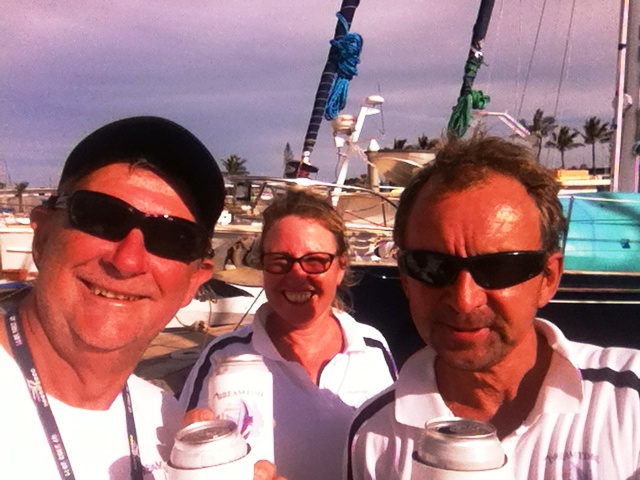 |
| Celebratory beers in the marina after the end of our shakedown cruise |
We had planned it as a shakedown cruise and it had been all of that. The most serious issues being a transmission failure in Bundaberg that cost us a month in port and more dollars than we like to think about and the refrigeration stopped working at Brampton Island on our way home. They are mechanical issues that can happen on any boat but we are pleased they happened here on our shakedown and not in some remote part of the Pacific.
We were super impressed with how well the boat sailed and learned a huge amount about how to get the best out of her. She proved to be a fantastic live aboard boat easily accommodating us and our guests, Anthony and Linda in the Whitsundays and, of course, our crewmate Marc for the whole trip south. We are delighted with our Whitby 42.
All that was left was a huge day of cleaning the boat from top to bottom. Our son, Rod, came to pick us up in the afternoon and we were very happy he has a truck as the amount of washing alone we unloaded off the boat near filled it. Then it was off to Ipswich to catch up with family and friends.
Marc stayed with us a few days longer to experience a typical, relaxed Aussie Christmas with our daughter, Yasmin, son-in-law, Rob, and our youngest grandies, Lyla and Harry. Christmas temperatures near 30C and lunch of juicy leg ham carved off the bone, kilos of fresh prawns accompanied by salads was far removed from anything he had experienced in jolly old England and a real eye opener for him.
 |
| Marc was in the Christmas spirit assisting to build the pirate ship fruit desert to impress the grand kids |

 |
| Kids are the excitement of Christmas morning |
 |
| G&T ice blocks for Christmas afternoon were a hit in the Aussie summer. |
It wasn’t until we saw him off at the airport for his flight back to London on Boxing Day that this leg of our adventures really felt totally over. We have sailed with Marc in South East Asia, the Mediterranean and now Australia and each time we have parted at an airport there has been no goodbye, but rather a “See you later.”
We love to receive comments on our blog from readers. If you do leave a comment and you also have a blog, please leave a link as well. We'd like to click over for a visit and leave you a comment too.
To stay right up to date with what we’re up to and see lots more photos check out and 'like' our Dreamtime Sail Facebook page at Dreamtime Sail
If you have only recently discovered our blog and would like to read how it all started, or work through our previous adventures, click the link to go back to our first blog entry. Stuff it. Let's just go sailing anyway.
We hope you enjoy reading the previous posts to catch up on our story.
Subscribe to:
Posts (Atom)


