Monday, November 28, 2016
Bob and Carol visit the Gulf of Mexico oil slick an unfortunate series of events occur


Bob now has an inkling there may be a real problem now, and he should get some help. For the first time on the trip, he turns on the VHF radio, and starts to yell "Mayday, Mayday". The Coast Guard answers, and starts to ask questions. One of the questions is, "where are you?". It takes Bob some time to figure how to get the TV off of the chartplotter thingy, and get it on a chart page with his position. He tells them the position, and seconds later, all power on the boat disappears. Bob thinks maybe they need those orange floating jacket things, but he doesn't know where they are, and besides, Carol wouldn't get into that black greasy water anyway. One of the kids suggests that the raft in a fiberglass box behind them would be useful. They all rush to the back of the bridge and stare at it. A cord is spotted, and one of the kids jerks it, and it explodes open just in time. The water is now at the bridge, and they all pile into the orange raft, just as the vessel gracefully sinks away underneath them through the thick black goo.

The goop in the water can be generically described as "Sweet Louisiana Crude" A crude oil is described as "Sweet", if it has less than .05% sulfur content. Crude oil is a hydrocarbon soup, that is processed into fuels (gasoline), solvents, and many other products. In its raw form, there are many materials naturally present such as Butane, Methane, Ethane, and many more "ane's" are on this list. All of these hydrocarbons can attack, and damage materials that are not designed to withstand contact with them.
So what does this have to do with with your boat. The chemicals present in the oil slick can attack gasket materials, and hoses that are not specifically designed to resist these hydrocarbons. Go to West Marine, and check out the cost differential between 10 feet of fuel line hose, and 10 feet of water line hose. There is a huge difference in price (400%), because materials designed to withstand degradation from hydrocarbons are much more costly to manufacture.
In Bob and Carol's case, I blamed the air conditioning system for sinking the boat, although I can certainly add many additional contributing causes. As the AC cooling water was pulled into the boat, the oil in it started to stick to the strainer basket, slowing the water flow, and hence the less cooling. The oil caused the raw water pump impeller to soften, and the hoses attached to the pump softened as well, and started to swell. With enough time, and pressure, the softened hose from the AC pump burst open, and the system starts to pump oily raw water into the bilge. This would run for a while, until the AC systems start to shut down, due to slow water flow, and the relays automatically turn off the pump. But by now the damaged impeller allows water to bypass it, and water still flows, but at a slower pace.
The generator suffered from a similar scenario, but in this case, the strainer just got plugged up with oil, and it did a high temperature shut down. It survives this time, but the entire cooling system will have to be flushed out, and the impeller replaced, at the minimum. This could be lot worse, depending on the type of cooling system it had.
I didn't talk about the head system, but if salt water was used for flushing, the oil can eat , or damage gaskets such as the joker valve, and hoses.You should also hope that manual heads had a vented loop above the water line, or this could have sunk the boat just as easily.
Now for the engines. In almost all cases, oil in the cooling water can go from just plugging things up, causing shutdowns, to destroying the engines. This goes for gas, diesel, and don't forget outboards. There are a myriad of scenarios here. In Bob's case, remember he smelled exhaust gas in the cabin? It could have come from a failed rubber exhaust elbow, that oil laden cooling water was passing through. It's tough enough job to keep cooling water away from the insides of engines, and transmissions with out worrying about all the gaskets that do that job, failing because of hydrocarbon degradation.
Can it get worse? Sure it can. How about coating your zincs with a nice thick film of oil, rendering them useless. Your ground plate for the single side band radio will also suffer the same fate. The pretty vinyl boot stripe won't like the oil, the hull can stain, and how about the water lubricated dripless stuffing boxes. I'm not sure, but I suspect cutlass bearings most likely won't like the oil either. The list here is almost endless. It's hard enough to keep a boat operating in a highly corrosive salt water environment. Add this nasty hydrocarbon goo to the mix, and you will really shorten your vessels life, and spend a lot of extra money. Did I mention the potential for a fire? A burst hose, or failed gasket spraying crude oil laden water inside a hot engine compartment, does not bode well if an ignition source was available.
The birds, and marine life aren't surviving it, and your pleasure boat won't either!

If you go down into the oil today
You're sure of a big surprise.
If you go down in the oil today
Your boat better be in disguise.
For ev'ry skimmer that ever there was
Will gather there for certain, because
Today's the day the BP Oil has their picnic
.
Want to help? Here are some sources
What is crude oil, and what's in it.
A small postscript about the story.
I received a flurry of comments today after I posted this. They range from they liked the beginning, but not the technical end, they hated the beginning, but liked the technical end, they liked it, and they hated it, it was too political, it will discourage boating, and it just made some people uncomfortable. I have fooled around with this story on and off today. It is what it is, and it will now stay this way.
This is a simple story. Bob and Carol, are the foils. They are the Eddie Haskell's of the world, and provide the set up for a general discussion of how the oil slick could affect a vessel. If the subject matter makes people uncomfortable, I'm ok with this, it should. I live In Sarasota Florida, a place with world renowned beaches, and a community whose primary income depends on these pristine beaches, boating, and fishing. It is also a community in denial. No task forces are looking into what to do if the oil gets to us. No planning is going on. We are advertising the fact that we don't have a problem, come visit, but no one is looking forward into the future, and we should be.
Tens of millions gallons have already spilled into the Gulf, and if you accept the the more conservative number of 35,000 barrels a day now being released into the Gulf. Thats 42 gallons in a barrel * 35,000 barrels = 1,470,000 gallons per day (NOAA estimate). Now lets just assume that the relief wells won't cap this problem until mid August, lets say 60 more days. The total gallons of crude oil released just over the next 60 days would be 88,600,000 gallons, or around ten times the Exxon Valdez spill. We can argue about the numbers, but they are staggering at any level. Now if you don't think this problem is going to impact Sarasota, and communities in the down stream flow of the Gulf Stream, including the eastern US coasts, you must have your head in the sand. Just ask someone from the coastal areas of Louisiana, what life is like now. Was it a bit political, yes. Did I try to make it a bit pointed, yes. Did it make you a little uncomfortable, I hope so. "
"We have met the enemy, and it is us". Walt Kelly.
Bill

Wednesday, November 23, 2016
Fixing an old failure scarfing a grip onto a sassafras northwoods Part 1
Here's an update on an old paddle failure. Back in 2012, I was working on my first sassafras paddle made from a thick 8/4 board, the only size I could source at the time. The inspiration for the paddle was a specimen in the Hudson Museum in Maine featuring a graceful, segmented grip

http://indigenousboats.blogspot.com


Anyway, the paddle blade was yanked out of the garden where it has weathered into a antique grey patina but came out without any sign of rot. The grip was pulled out of indoor storage and the two setup on the garden shed to represent what could've been...

With a scrap piece of sassafras cut from more recent projects, a plan was hatched to try a scarf repair like David's.

Using a mitre saw, I cut the steepest angle I could manage. Here is a shot of the scarf joint clamped up...

Thursday, November 10, 2016
How to mount an electric motor on a canoe
How to mount an electric motor on a canoe is a movement with modern preferred subject material, small children with the study of your seo in order to provide accurate information we tend to make an effort to look for imagery based on a How to mount an electric motor on a canoe . and then the good results you will discover following you should be aware many of the photographs is only some sort of illustration.
illustration How to mount an electric motor on a canoe

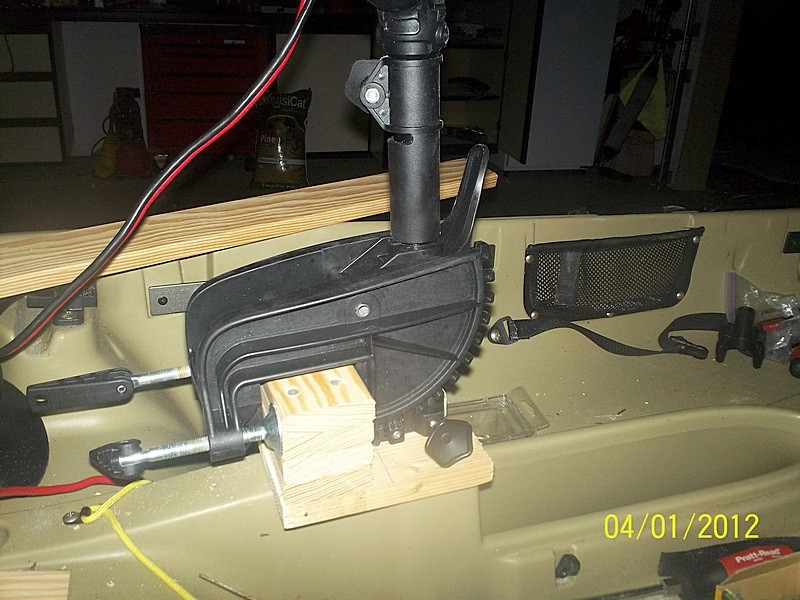


How to mount an electric motor on a canoe - this has happen to be uploaded with the hope which most of us will probably encourage employed to you will. This information could provide as being a reference point if you are puzzled to choose the proper information The How to mount an electric motor on a canoe posts may be your best option for being given to the effort approach, because contains specific to it schedule might believe alot more convinced How to mount an electric motor on a canoe - Valuable suitable for you consequently all of us want to discover a trusted supply that will help you find inspiration without confusion. never forget to help you store this site, given that could be someday you may need it all to come back simply because ones own inspirational options.
Saturday, October 15, 2016
Book Release Dorade The History of an Ocean Racing Yacht

Yesterday I was very pleased to have received a copy of Doug Adkins fine book entitled Dorade, The History of an Ocean Racing Yacht. The book has recently been released in a limited edition run of 250. I have never seen a book so well done. The book comes in a fabric bound box and includes a set of drawings including the sail plan, accommodations and construction plans, a high quality image of the cover shot and a leather book mark that is a copy of the famous lapel ribbon worn during the ticker tape parade back in 1931.

I received the following thoughtful note from the author.

The book is the most complete history about the boat that can possibly be imagined and includes all kinds of information about Olin, Sparkman & Stephens and related matter. Granted it's expensive at $250 but based on this publishers previous effort: Lines by Olin J. Stephens II, it should appreciate rather quickly. When the Lines book was released it was done so in two formats: a limited edition run of 250 with fabric covered slipcover and a standard run in plainer binding. The limited edition version cost $250 as well. The limited edition copies are now trading for as much as $2,300.
Click here to access the Dorade book website and learn how to order the limited edition version. A "standard" trade edition of the Dorade book is also available for $65. It is a hardbound copy with dust jacket. Click here for ordering instructions.
Thanks Doug for sending us a copy and congratulations on a monumental achievement.

Wednesday, October 12, 2016
Anchored in Townsville under an awesome Air Show
12-16 October 2016
 |
| Motoring on glassy seas through the Palm Group of Islands. |

 |
| Rattle Snake Island is a RAAF practice range for fast jets. |
 |
| It was fantastic when the wind picked up enough to turn the engine off and enjoy the sailing. |
 |
| Our Dreamtime loves the wind square on the beam making good speed in light conditions. |
 |
| The light and shadows combined to produce a very grumpy emojo face on Townsville's Castle Hill as we approached. |
 |
| Orpheus Island to Townsville - 45.0 Nautical Miles - 8 Hours 02 Minutes Average Speed 5.6 Knots - Max Speed 7.8 Knots |
 |
| Townsville's Duck Pond can provide a shallow but free anchorage adjacent to the centre of the city. |
 |
| Sunset from Townsville's Duck Pond anchorage. |
 |
| A stark reminder that we were in Crocodile country was this trap complete with pig's head bait in Townsville's Duck Pond. |
 |
| We were very impressed with Townsville's redeveloped Strand. |
 |
| The public facilities such as this BBQ area are first class. |
 |
| No need for a gym membership when there is such good outdoor exercise equipment in the park. |
 |
| Not all is at it first seems. |
 |
| A fun piece of public art. |
 |
| No shortage of fun for the kids here. |


 |
| Townsville's Strand provides plenty of options for a dip. |
 |
| The rock pool is excellent. |
 |
| A couple of the Townsville locals we came across. |

 |
| Fresh prawns, Moreton Bay bugs and bubbles waiting for the air show to start. |
 |
| An hour earlier there was not one boat anchored behind us. |
 |
| We could not have asked for a better view of the T150 Air Show. |
 |
| The sound of the V12 Merlin engine in this P51 Mustang in RAAF colours was glorious. |
 |
| The very LOUD RAAF F/A-18F Super Hornet put on a brilliant display |
 |
| Vapour pours off the USAF F16 Fighting Falcon in a loop over our boat. |
 |
| The RAAF Roulettes in tight formation flying the PC-9/A |
 |
| Flares fired off by a C130 Hercules and PC3 Orion were the perfect way to launch very long and spectacular fireworks. |
 |

 |
| The reflections over the water added a great dimension to the fireworks. |

 |
| Townsville's Maritime Museum was well worth the visit. |
 |
| The WW2 exhibit was very informative. |
 |
| This model of HMS Pandora that sank on the Great Barrier Reef after arresting Bounty mutineers was one of many. |
 |
| Karen with a model of the SS Yongala which foundered south of Townsville in a cyclone. |

 |
| We did like the sense of humour of museum's volunteer staff. |
 |
| Good afternoon from Townsville. |
We love to receive comments on our blog from readers. If you do leave a comment and you also have a blog, please leave a link as well. We'd like to click over for a visit and leave you a comment too.


