Showing posts with label Lakes. Show all posts
Showing posts with label Lakes. Show all posts
Sunday, December 18, 2016
Chain of Lakes May 2
Two days of wind and rain followed by a day of wind and rain and how has brought the river levels up several feet. The Quinnipiac and the Farmington are well out of their banks and into the trees and it can be assumed that all the others have followed suit. Exploring the bottom of the Scantic is put off.
So, I head to a small chain of three lakes, each separated by a short portage, which only serves to make the trip more worthwhile...the act of lifting and carrying the boat from one body of water to the next being what canoes were made for.
The first lake is housed, an older development plan that let people build all too close to the water... but even that seems to have purpose in the journey. I paddle away from town across and up the egg shaped lake to the far end and towards something farther away.
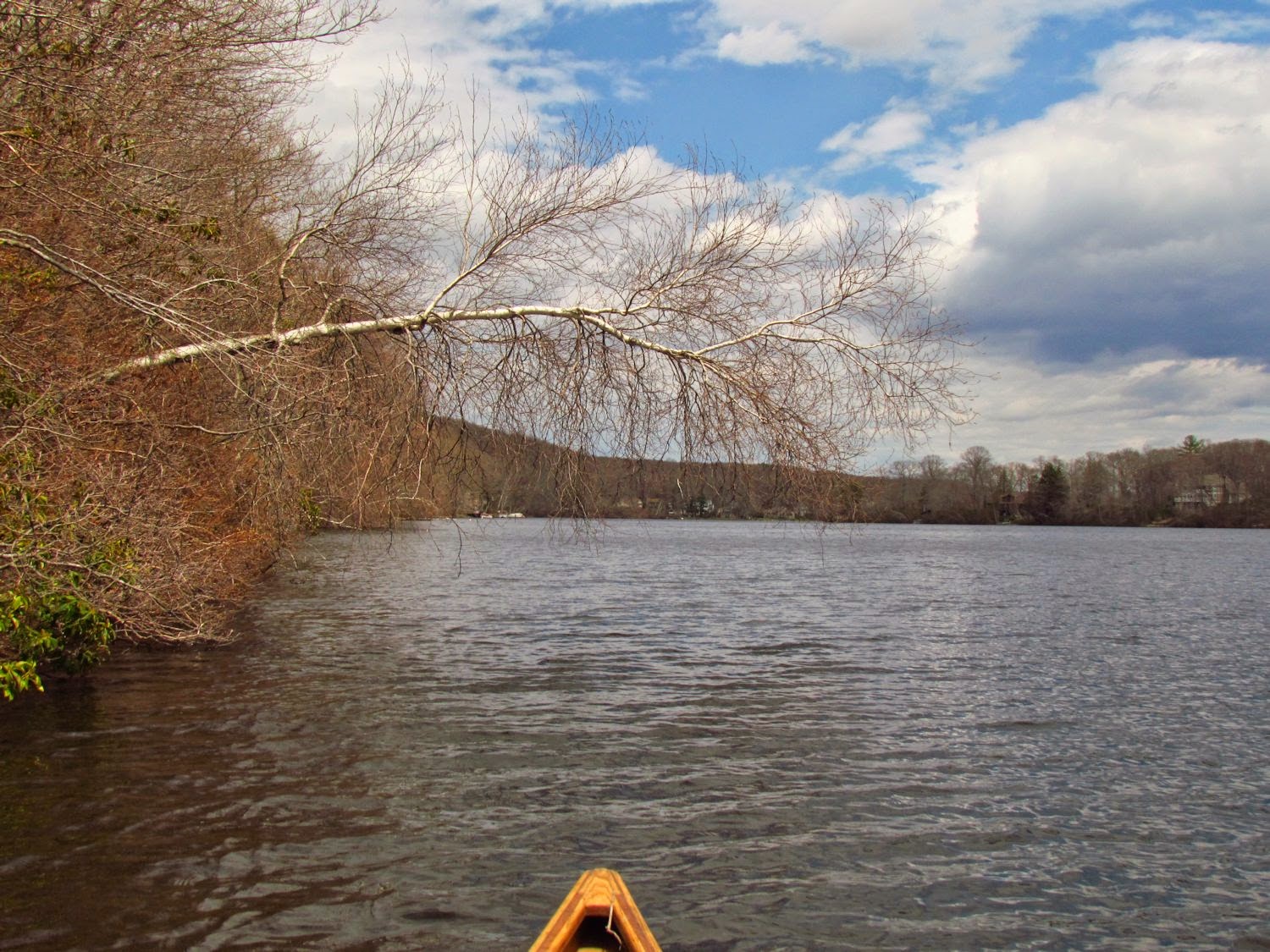
Just as I reach the top of the lake, a mature bald eagle drops down off the forested hillside and sweeps off leading the way. I grunt the portage...so short that except for my pack and one paddle, I leave my other gear in the canoe and forgo throwing it up on my shoulders, just manhandling it into the second lake, where I slip off the bank and perform the wetting of the feet ceremony. This second lake has houses also, but they are back farther from the shore, which is only half developed, and the lake has a dogleg in it with a rather fine stone gazebo at the point, which would bother me if it wasn't such a fine classic design.
The second portage is easier, being just as long, or short as the case may be, but without a hump to carry over. I guy is fishing there on his lunch break. We have a short chat before he figures out that I'm not fishing. Usually, if fishermen figure out that I am canoeing without fishing before talking with me, they treat me as if I was deranged. If we do it the other way around, I end up being one of the guys. I do like to pick their brains and get their observations since they have a different focus on it all. He did not see the bald eagle, if it came this way.

It is this third lake that is the pearl of the trip. It is S-shaped and has just two or three houses that can be seen from the water. The first is at the portage and the others are high and away from the lake...and they can and should be ignored. The lake is shallow enough that I bet one could wade across it most anyplace. It is also exactly the right depth to grow lily pads, and by June it will be blanketed in them and nearly uncanoeable. A rocky forested ridge forms much of the east shore while the rest of the boundary is low wetland or swamp. An osprey perches in a tree on the east shore until I come too close, whereupon it gets up and moves to a tree on the west shore (later, it will reverse the process). I flush a great blue heron, which moves off no farther than it feels necessary so that it continue hunting without having to watch me.

Canada geese and I spot two nests on isolated hummocks that are well out in the lake. The closest one has eggs but the female has left the nest. I'm not to blame as she was gone well before I got near...I spotted her head low swimming next to her mate. I've observed geese before, I've never seen them leave a nest like that unless it has been raided. I move past as quickly as I can.
I spend less time in the swamp than I planned keeping in mind the stiff grind that the return trip could become. The high water makes it a good day to explore the narrow channels that lead into the low cedar tree swamp, but the wind...


And then I work my way back to town.

Wednesday, August 3, 2016
Great Lakes Boatbuilding School joins the project

CW Morgan at Mystic with a whaleboat in the foreground.

A raised lofting table was constructed in the school's loft for the whaleboat.

Lofting details

Deciding if the lines are fair
.JPG)
Freshly steamed stem being inserted into the bending jig and bent to shape using a compression strap.

Stem secured in bending jig. Note the custom fabricated compression strap attached to the jig at one end and the handle at the other end.

Chopping the rabbet into the stem

Construction of the backbone begins

Building jig is erected, backbone assembled, and molds are secured in place.

Garboard plank hung along with a lapped-straked plank above it on the starboard side. The following planks will be done with carvel batten-seams.

Bottom two planks on the port side completed. Note the notches in the molds for the batten seams that were laid out during the lining off process.

The whaleboat seen amongst all the other developing projects in the shop.

First lapstrake plank below the sheer being hung.

Students slowly bend the a frame over the jig using a compression strap.

Steamed frames are drying in bending jig as planking work continues.

With the completion of planking, work shifts to installation of the pre-bent frames.

Clamping the frames in place.
All images courtesy Great Lakes Boatbuilding School
"The Great Lakes Boat Building School (GLBBS) is proud, honored, and excited to have a role in the Mystic Seaport museum’s restoration of the Charles W. Morgan."
So begins the glbbs short dissertation on the project, with a history of the Morgan, a nicely done description of the whaleboat in general and the Beetle craft in particular and a statement of their expectations and the merit of taking on such a project. As with most of the participants in the project, Great Lakes is using the build as a learning experience for their students. Indeed, their website outlines in great detail what the students will be learning. Here is a taste of that:
"First and foremost, in the building of this whaleboat students will learn team work. It has been said, “To work with someone is to know him; to build a boat with him is to know him well.“ And so it goes at GLBBS.
The process begins with the preliminary work being done by second-year students, while the first-year students are being introduced to classic woodworking skills, which involves building their toolboxes and being introduced to the fundamentals of lofting. Second-year students, having learned the required lofting skills in their first year, will loft the whaleboat to establish its full-size lines, which then will be used to form the necessary references and patterns required for accurately building this boat to the Beetle design.
Second-year students will continue on with the next step, which is using the lofting lines to make the molds representing the hull shape, then setting the molds up in a building jig. The building jig is designed for building the whale boat right-side up, and also to allow plenty of height underneath for working on the bottom of the whaleboat.
Once the second-year students have completed the building jig, the actual boat construction begins with the building of the backbone. They will build a keel, stem, and sternpost. In this process, they will gain more experience in constructing a bending jig, as well as the steam bending process involved in bending the stem and sternpost. When the stem and stern post have been bent to shape, students will learn how to layout and carve the rabbet into the stem and sternpost and assemble them together on the building jig to form the backbone of the whaleboat."
Suffice it to say, there's a lot more.
My sincere thanks to Kevin Pagliuca at Great Lakes for his assistance.
Subscribe to:
Posts (Atom)


