Showing posts with label Museum. Show all posts
Showing posts with label Museum. Show all posts
Wednesday, November 30, 2016
Parkdale Maplewood Community Museum Mikmaq style canoe paddle
The Parkdale Maplewood Community Museum in Nova Scotia has a Mi'kmaq style bark canoe on display.

Accession number: 1946.Y.004 a
Date: 1862 - 1943
Measurements: 750.3 cm; 77 cm; 28 cm
Source Link
Parkdale-Maplewood Community Museum
As per NovaMuse Educational Policy
According to the description, the canoe was made by John "Stephen" Rafuse. The exterior of the canoe has painted a deep shade of green, however the interior remains an unpainted. Root lashings aren't visible and there appears to be a green painted inwale so it is likely held together with nails.
Another shot from the Museum's exhibit page shows the same canoe with a fishing net and an accompanying green paddle...

Parkdale-Maplewood Community Museum

Parkdale-Maplewood Community Museum

Friday, November 11, 2016
Canoe Model with Decorated Paddles Mashantucket Pequot Museum Research Center
Google's Cultural Institute site has large photos of the birchbark canoe model in the collection of The Mashantucket Pequot Museum and Research Center. Dated to 1780-1820, the souvenir artwork piece features dolls, a sail and paddles along with some highly ornamented decorative paintings.

Canoe Model with Dolls - 1780 - 1820
The Mashantucket Pequot Museum and Research Center
Source Link
Here is the description on the page:
This model canoe with its accompanying dolls and accessories was the product of French Canadian nuns and Abenaki or Huron converts working together in a thriving cottage industry in Montreal and Quebec. Many of the items they made were sent back to Europe either as gifts to Catholic churches in France or to fill the curio cabinets of Europe’s elite.

Paddle Decoration Closeup
Similar souvenir based canoe models traced back to Quebec nuns and First Nation artisans are the model at the CMC, the Farquharson Model sold at auction in 2005, the Chartres Canoe Model and the Neuchatel model. The decorations on the paddles all give a clue to the style of paddle art being made at the time.
Wednesday, November 9, 2016
Adirondack Museum Paddles
Ever since getting a copy of Dr. Gordon Fisher's recent publication, Guideboat Paddles: An Adirondack Treasure, I've been curious about some of the paddles apparently on display at the Adirondack Museum in Blue Mountain, New York.
I stumbled on a few personal photos on Flickr and Picasa of folks who've visited the museum and happened to get shots of the paddle display. Here's one from deshantm revealing 4 distinct paddles on a mounted display. The first two paddles have some interesting blade designs and grip style.

Adirondack Museum Paddles
Flickr user Alan Teichman, also had a shot illustrating the same paddles, but managed to get a clearer shot of the captions.

Photo Authorship Credit: Alan Teichman
Given the resolution of the original photo, here's what I could make out for the paddles (left to right)...
• Single Bladed Paddle made by Bradly ?, a young medical student on vacation in the Adirondacks around 1900. He copied the shape from an Abenaki model and added the Indian motif on the grip for a "romantic look"
• Single Bladed Paddled made by Dr. George Everett at Lake Ozonia for Dr. Edward Prescott of Potsdam. Dr. Everett was a summer resident who made cherry paddles as a hobby finishing them scraping with a broken piece of glass and applying a mixture of linseed oil, turpentine and vinegar
• Single Bladed Paddled designed and made by James McCormick around 1934. McCormick was a carpenter and boat builder...he made over 500 paddles of cherry and maple before his death
• Single Bladed Paddled purchased with a Rushton Indian Girl canoe. The owner added the red paint, his initials and the ??? to give the paddle a more romantic native look
I really wish museums would consider adding more virtual galleries on their websites. I think it encourages more interest in visiting the museum to see artifacts such as this in person.
Wednesday, September 14, 2016
Hudson Museum Paddles Thanks Bob Holtzman
Bob Holtzman runs a great blog on indigenous watercraft from around the world which includes some discussion on birchbark canoes. A recent post outlines some fantastic museum paddles from the Hudson Museum in Maine.
I especially liked the local paddles on display, one of which Bob mentions has metal strips to repair a serious split. The bottom two are long stern paddles which seem like early incarnations of the modern Northwoods paddles documented by the Conovers

Paddles from Maine
In the photo below, I'm really drawn to the grip style of the paddle on the left, a segmented grip that is reminiscient of my own version that I'm working on. This one has much more fluid lines however, especially with the additional indented edges. Had I not already thinned out my grip and balanced the paddle the way I like it, I think I would've preferred this style. Oh well, there's always the next paddle.

Segmented grip
Also on display is a decorated paddle from the Amazon with an interesting tip, perhaps to get a grip on shallow, muddy waterways when poling upriver.

Its design is similar to another Amazonian paddle I posted on earlier from a now completed online auction.

Amazonian Decorated Canoe Paddle, 60.5"
From the Estate of John Auraden of Hamilton & Fairhaven, Ohio.
Many thanks to Bob for taking these pics and giving us an inside glimpse of what the museum has to offer. If I ever make it out to Maine, I think I'll be checking it out in person.
Friday, September 2, 2016
Hudson Museum 2 Paddles
Scattered among various exhibit cases at the Hudson Museum of Anthropology (see previous post for a brief introduction) is a nice collection of canoe paddles.


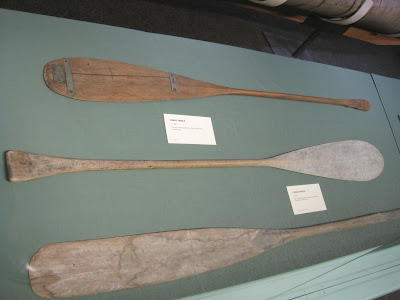

A Shipibo canoe paddle (c.1940) from the Ucayali region of the central Peruvian Amazon. Used with a dugout canoe, of course. (All photos are clickable for a larger image.)
Another paddle from the Amazon, c. 1950.
A Tlingit paddle, c. 1880. If anyone can make out the design motif on this, please post to the Comments.
Three paddles from Maine, probably all Wabanaki and probably all carved with crooked knives. The top one must have been well-loved: note how it was mended with metal straps. The middle and bottom are long stern paddles.
The same three paddles as the previous photo. Interesting segmented extended grip on the longest one.
Friday, August 5, 2016
Canoe Depictions at Abbe Museum
In my previous post, I introduced the Abbe Museum of Bar Harbor and ran photos of its sole bark canoe. We'll stay at the Abbe in this post, looking at various depictions of canoes on display there. (Click any image to enlarge.)


 |
| The Indian god Glooskap. From display signage: "Is Glooskap still living? Yes, far away; no none knows where. Some say he sailed away in his stone canoe beyond the sea, to the east, but he will return in it one day." Another sign reads: "Glooskap built a stone canoe. He worked a year at it. Then he dried meat and so provisioned the canoe with food and water. Along with his grandmother woodchuck, Glooskap sailed across the sea. This was before White people had ever heard of America. The White Men did not discover this country first at all. Glooskap discovered England, and told them about it." So there! |
 |
| Mail pouch by Tomah Joseph, Passamaquoddy, 1890. Birch bark and ash. Upper left shows four canoes near a shoreline with a flagpole. Lower right shows a groundhog sitting in a stone boat. The the other figure in the boat is not identified. |
 |
| This picture and the next two: Model canoe, ca. 1900, probably Micmac. Birch bark, rattan, cedar, ash, porcupine quill decorations on side. Models like this were built in large numbers by Mt. Desert natives as tourist souvenirs. Accuracy was clearly not an objective in these models: they were meant to represent canoes in a general way for an undiscerning audience, and the decoration was probably more important than the canoe's shape or construction. |
 |
| It does look nice in plan view though. |
 |
| Colored quill decoration on the sides. |
 |
| Above and below: bark boxes showing canoe images, also typical tourist-trade goods. |
 |
| This photo and the two following: Large Wabanaki birchbark canoe model (probably about 28 inches LOA) by Harry Jordan, ca. 1930. Birchbark, ash, maple, cedar, pitch. Paddles and poles of maple. |
 |
| Elaborate binding of the gunwales near the ends. I'm unfamiliar with the flap that's lashed atop the intersection of the gunwale ends -- it's not like the wulegessis, that folds under the gunwales and overlaps the top of the hull sides.. |
 |
| This view shows the headboard clearly, and the unusual way it's bound in place. |
 |
| This photo and all that follow: four nicely made dioramas show Wabanaki subsistence activities through the four seasons. The winter scene showed no canoes and is not included here. The first two images are, I believe, fall, the next two are summer, and the final two are spring, but I didn't take good notes and I may have these mixed up. In any case, they're nice believable depictions of canoes in prehistoric native context. (For scale: the human figures are about 5 inches tall.) |
 |
| Building a canoe. |
 |
| Pulled up on a beach for repairs. |
Subscribe to:
Posts (Atom)


