Wednesday, November 30, 2016
Rob Stevens Paddles W C Canoe Restoration
• 2 American Chestnut
• 2 Sassafras, including a northwoods style with notched handle
• 2 black cherry


Friday, November 25, 2016
Historic Illustration Iroquois Elm Canoe and Paddles
League of the Ho-dé-no-sau-nee or Iroquois, the work of Lewis Henry Morgan (1818-1881) has sketches of typical Iroquoian artifacts ranging from clothing to weapons to baskets. Volume III includes a write up on the elm bark canoes used by this tribe as well as an illustration.

Elm Bark Canoe
The image dates from 1849 and clearly illustrates the crimped bark of this type of craft, equipped with paddles for a crew of six. Some of the paddles have the decorations on them, simple cross hatched patterns with other carved figures, likely the personal marks of the owner. Here are some closeups.

Marked Paddles - Man with staff/club?

Horse Decoration?
Wednesday, November 9, 2016
Adirondack Museum Paddles
Ever since getting a copy of Dr. Gordon Fisher's recent publication, Guideboat Paddles: An Adirondack Treasure, I've been curious about some of the paddles apparently on display at the Adirondack Museum in Blue Mountain, New York.
I stumbled on a few personal photos on Flickr and Picasa of folks who've visited the museum and happened to get shots of the paddle display. Here's one from deshantm revealing 4 distinct paddles on a mounted display. The first two paddles have some interesting blade designs and grip style.

Adirondack Museum Paddles
Flickr user Alan Teichman, also had a shot illustrating the same paddles, but managed to get a clearer shot of the captions.

Photo Authorship Credit: Alan Teichman
Given the resolution of the original photo, here's what I could make out for the paddles (left to right)...
• Single Bladed Paddle made by Bradly ?, a young medical student on vacation in the Adirondacks around 1900. He copied the shape from an Abenaki model and added the Indian motif on the grip for a "romantic look"
• Single Bladed Paddled made by Dr. George Everett at Lake Ozonia for Dr. Edward Prescott of Potsdam. Dr. Everett was a summer resident who made cherry paddles as a hobby finishing them scraping with a broken piece of glass and applying a mixture of linseed oil, turpentine and vinegar
• Single Bladed Paddled designed and made by James McCormick around 1934. McCormick was a carpenter and boat builder...he made over 500 paddles of cherry and maple before his death
• Single Bladed Paddled purchased with a Rushton Indian Girl canoe. The owner added the red paint, his initials and the ??? to give the paddle a more romantic native look
I really wish museums would consider adding more virtual galleries on their websites. I think it encourages more interest in visiting the museum to see artifacts such as this in person.
Friday, October 28, 2016
Building wooden canoe paddles
Building wooden canoe paddles could be the craze regarding present day well-known articles, we understand within the exploration within the se that you should provide you with genuine ideas most of us look at looking for graphics regarding any Building wooden canoe paddles . additionally, the gains you can understand less than twelve common the various graphics is probably a strong example of this.
illustration Building wooden canoe paddles


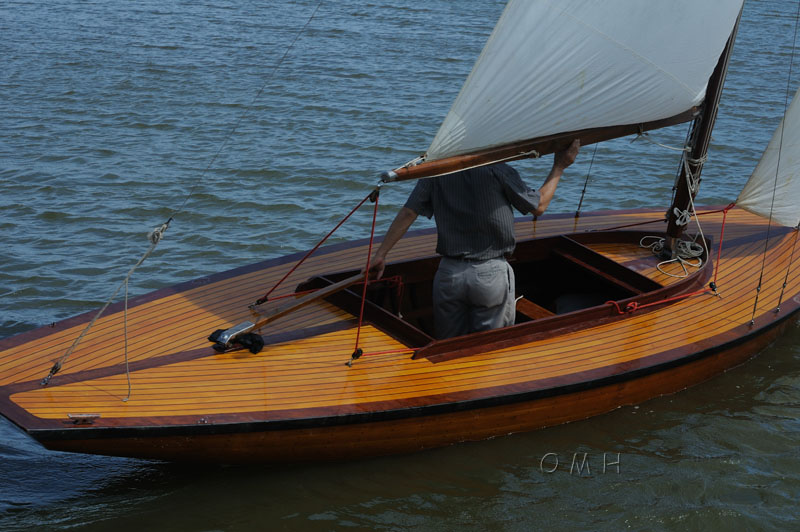
Building wooden canoe paddles - it's become released with the expectation which will you can easlily motivate employed to you will. This post can certainly work to be a referrals for all those confounded to find the most suitable help The Building wooden canoe paddles articles might be your very best choice to remain utilized on their work schedule, as it has its own plan will feel more satisfied Building wooden canoe paddles - Very helpful for you personally consequently all of us want to discover a dependable resource which usually can assist you get encouragement not having turmoil. do remember for you to book mark this page, due to the fact possibly 1 day you will require that again when a person's inspirational strategies.
Wednesday, October 26, 2016
Oars and Paddles in Cape Town
Hi Roy

Saturday, October 15, 2016
Historic Paddle Photo Maliseet Guide with Paddles
Another paddle photo find in the December 1910 issue of Rod and Gun in Canada ( Vol. 12, No. 7 ). The article entitled, "A New Brunswick Canoe Trip on the Fascinating Tobique" by Stephen B. Bustin features an image of the Maliseet guide posing with a slim guide paddle with tapering grip.


Monday, October 3, 2016
Chippewa Canoe Paddles
Some more paddles from LiveAuctioneers.com, these ones being Chippewa (Ojibway) paddles with straight bladed, efficient designs and simple grips.

Chippewa Canoe Paddle
Length: 56 inches.
Early 20th century
Full Link

Chippewa Wooden Canoe Paddle
From Pine River area in the upper peninsular of Michigan
Length: 64 inches
ca 1890
Full Link
Monday, September 26, 2016
Wood canoe paddles
Wood canoe paddles is actually among the information beneath the today We understand within the checklist msn For you to offer you helpful tips to your readership we tested to obtain this most adjacent importance graphics all around Wood canoe paddles As well as right here you will observe right now, these images have been taken from the leading resource.

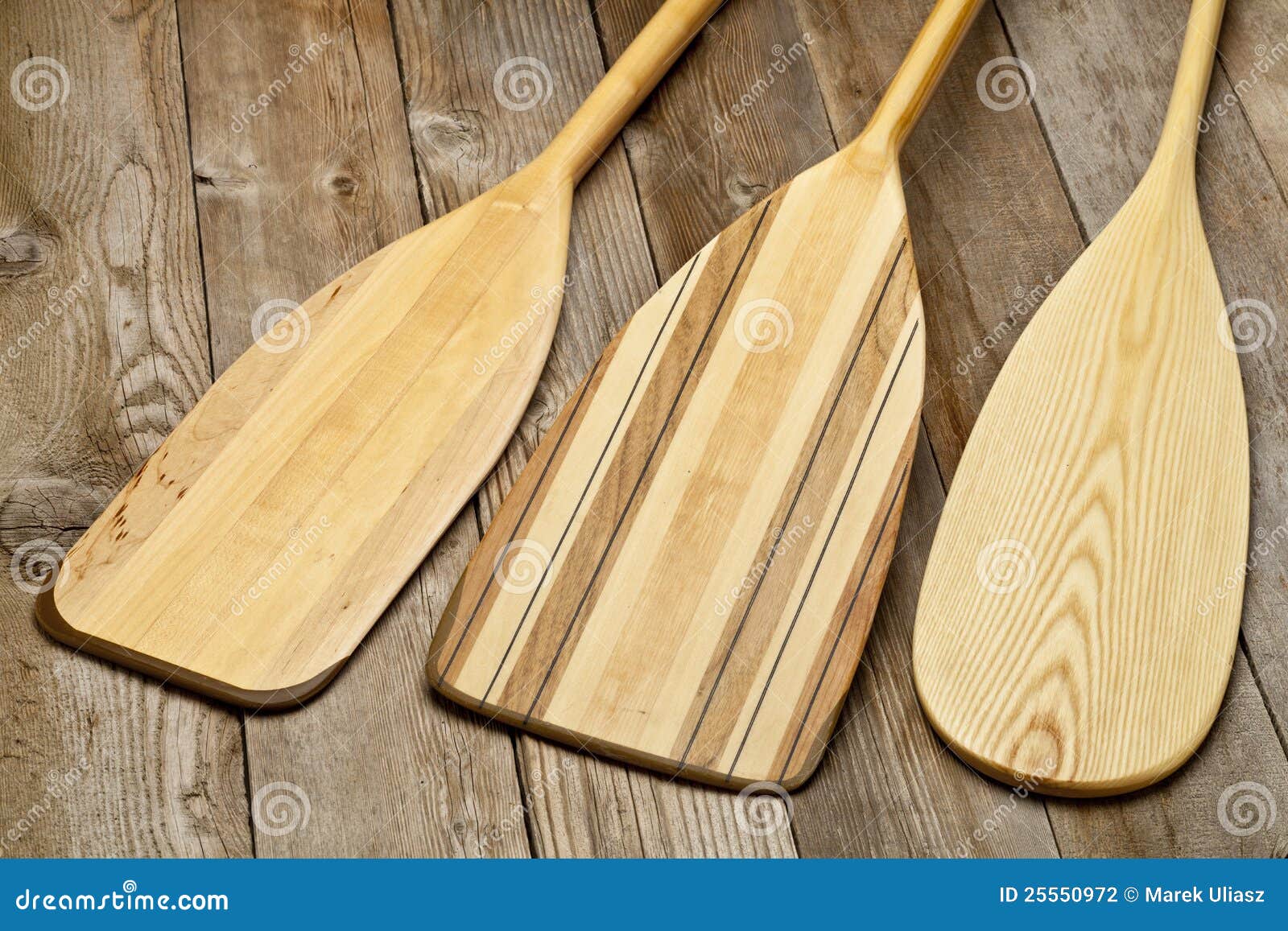


Wood canoe paddles - this has been posted with the hope what individuals we can easily really encourage employed to people. This particular blog post will be able to fulfill to provide a blueprint when you find yourself perplexed to find the appropriate guidebook The Wood canoe paddles reports could very well be your opportunity to get used on the project prepare, precisely as it seems to have the liechtenstein package definitely will look further thrilled Wood canoe paddles - Worthwhile for your needs for that reason many of us making the effort to come across an honest supplier which often will let you uncover enthusiasm devoid of bafflement. keep in mind to help search for this site, because maybe one day you will need it back seeing that ones inspirational thoughts.
Wednesday, September 14, 2016
Hudson Museum Paddles Thanks Bob Holtzman
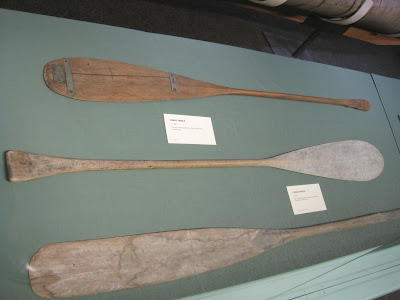
Bob Holtzman runs a great blog on indigenous watercraft from around the world which includes some discussion on birchbark canoes. A recent post outlines some fantastic museum paddles from the Hudson Museum in Maine.
I especially liked the local paddles on display, one of which Bob mentions has metal strips to repair a serious split. The bottom two are long stern paddles which seem like early incarnations of the modern Northwoods paddles documented by the Conovers

Paddles from Maine
In the photo below, I'm really drawn to the grip style of the paddle on the left, a segmented grip that is reminiscient of my own version that I'm working on. This one has much more fluid lines however, especially with the additional indented edges. Had I not already thinned out my grip and balanced the paddle the way I like it, I think I would've preferred this style. Oh well, there's always the next paddle.

Segmented grip
Also on display is a decorated paddle from the Amazon with an interesting tip, perhaps to get a grip on shallow, muddy waterways when poling upriver.

Its design is similar to another Amazonian paddle I posted on earlier from a now completed online auction.

Amazonian Decorated Canoe Paddle, 60.5"
From the Estate of John Auraden of Hamilton & Fairhaven, Ohio.
Many thanks to Bob for taking these pics and giving us an inside glimpse of what the museum has to offer. If I ever make it out to Maine, I think I'll be checking it out in person.
Friday, September 2, 2016
Hudson Museum 2 Paddles



Tuesday, August 23, 2016
Canotrouges Sitka Spruce Paddles
I recently got in touch with a fellow paddle maker over on the CanoeTripping.net forums who goes by the handle Canotrouge.
Originally from Quebec, he's now living the life most of us outdoor lovers can only dream of, way up in Canada's beautiful Yukon Territory. Here's a little writeup I asked him to provide about his paddle creations:
"I use mainly sitka spruce, because it is light, stiff and somewhat easy to get up here and at a fair price. I did a few out of cherry and walnuts, ash and a mixed of all of them, I like them also, but they are so much heavier.
I get my inspiration from the eastern Canadian first nations, but with my own touch, I'm not into accurate reproduction of let say a Maliseet or Passamaquoddy or Cree, but I use some of their characteristics to create my paddles.
All my paddles have a reinforced tip of hard wood, mainly white ash and several coats of spar varnish (at least on the blade) after I put several coats of boiled linseed oil and or Tung oil. I some time use milk paint or aniline dye to colour the blade or other parts of the paddle."
Here are just a few photo samples of his lovely work. More closeups can be found on his Pinterest page...


Canotrouge's talents are not just limited to paddles. For more of artistry and woodwork, be sure to check out the facebook page for his workshop - Au Nord du Nord Woodwork.
Monday, August 22, 2016
Heritage Paddles by Pyrographic Artist Dot Bonnenfant
For those who appreciate fine, pyrographic paddle art, check out the amazing work of Dot Bonnenfant of Heritage Paddles. Her gallery page contains a wonderful array of designs including samples inspired by native artwork, natural scenery and symbolic decoration with special meanings for the recipient.
Three of my favourite designs include her version of the well documented, 19th Century Passamaquoddy / Maliseet at the McCord Museum in Montreal.

Dot was also commissioned to make a paddle as a presentation gift for the 2007 Heritage Rivers Conference - Bill Mason Award. This paddle was presented to well known Canadian Wilderness Guide, Author and Artist, Hap Wilson. Her design was inspired by aboriginal bead and porcupine quill work. Years ago, I got a chance to see this paddle up close when Hap was visiting the Toronto Outdoor Adventure show. The textured burning was amazing requiring a very steady hand and much artistry.

Not just limited to abstract designs, Dot has also done burnings of an ancient art form known to many canoe trippers...petroglyph artwork. The paddle set below was made as a wedding present for a family who have canoed and camped near petroglyph sites in Ontario.

As an aside, Selwyn Dewdney's 1962 publication, Indian Rock Paintings of the Great Lakes is available for full preview on Archive.org. The book is one of the most detailed works on petroglyph art in paddling country and contains many images along with some of their interpretive meanings.

More of Dot's inspirational burnings can be seen on her Facebook Page. For anyone seeking a truly unique paddle gift from a master woodburning artist, the contact info for Heritage Paddles can be found here.
Friday, August 19, 2016
Sevareids Ports Canoe Paddles
Just re-read the paddling classic, Canoeing With the Cree documenting the momentous trip of Eric Sevareid and Walter Port as they traveled from their home in Minnesota to York Factory on the shores of Hudson's Bay. The book is not just any travel journal however, it is a fascinating historical glimpse of simpler time and ...


Book Covers
The read got me curious about the gear these 2 teens used on their trip. A passage I found which describes the purchase of their canoe states:
"Our canoe was 18 feet long, an American made cruiser model, with a wide beam and a small keel...The Sans Souci, we chistened her. That was Walt's idea. It means "without care." We painted on her, "Minneapolis to Hudson Bay." In order to beat other buyers for the canoe, which was secondhand and on which the middle thwart was missing, we had to skip some of our final examinations."This matches the classic photo below of the pair about to launch their canoe at the start of their journey. Sure enough the middle thwart is missing (which would mean a two person carry of the canoe at each portage) only to be replaced with a massive load of packs.

Sevareid and Port launching
Further mention of their paddles is found in the equipment list that Sevareid prepares for the book. It includes mention of "three, five foot, copper-tipped paddles". I guess copper tipped paddles were the rage back then and considered necessary for expedition purposes. What caught my eye was the paddle length chosen for both boys (5ft) despite the dramatic height difference between the friends. Here's another photo from an archived article on the trip

Eric Sevareid and Walter Port at the start
of their canoe trip to Hudson's Bay
Date: 6/1930
The paddle just reaches Port's chin which is the paddle length dimension I've found comfortable to use, but look at the paddle dwarfed by Sevareid's tall frame. He makes it look like a child's toy! I wonder how it could have been comfortable for him to use?
At any rate, the book mentions how the canoe and gear were left behind at York Factory so it is likely these have been reclaimed by the ravages of time.


